


to read: books
Skipping School — Dixie Dillon Lane — It’s been a joy to follow her writing over the past years, and she’s grown to be a writer and person I really admire. It was incredibly fun to chat with her, along with a few others, in person at the Front Porch Republic conference in Madison a few years ago. (Quite serendipitously, I happened to run into Brad East in the same city last week. What a world.) Anyways, here’s my brief review of her hard-won and worthwhile book.
Beauty: A Theological Engagement with Gregory of Nyssa — Natalie Carnes —
Truthfully, I was not certain what I was getting into with this book. So the academic nature of it somewhat threw me for a loop. Nevertheless, it was one of several books on beauty I’d like to slowly work through.
Some of the ones I’m eyeing are in this Theology of Beauty syllabus from W. David O. Taylor which I’d been hoarding for years and rediscovered. Other titles for my own list include Roger Scruton’s Beauty (have read), Byung-Chul Han’s Saving Beauty, and Timothy G. Patitsas’ The Ethics of Beauty.
Questions of beauty are at the heart of theological knowledge. Beauty is central to theology, not only because through beauty we see the true and love the good, but also because at the heart of Christianity is the conviction that Christ is the form of God, that it is “through form [that] the lightning-bolt of eternal beauty flash[es].”
Human nature must be wounded (as Paul was stigmatized by blows and weakness) in order to see the beauty that it possesses (the beauty of the soul) and manifest the wounded nature of Christ (it is the marks of Christ that Paul bears).
The beauty of the soul is simply revealed; it is the non-eschatological beauty of the human person. Yet it is a beauty that is revealed only through wounding, only through bearing the marks of Christ that give one the Christ-likeness the human will eschatologically possess. The beauty of humanity is fully revealed only through the Spirit’s wounding the human into Christ-likeness, into her eschatological self. Spirit-wounding gives us a way of seeing and a way of becoming.
In holding together the glories of perceiving beauty with the distress of wounding, Gregory communicates to his reader the difficulty of perceiving beauty, the way its right perception requires a radical break from the catechesis of the world.
Woven Well — Caitlin Estes — This is the bridge book we need to begin so many other needed conversations in marriages, churches, and elsewhere. Here’s our interview.
The Castle of Llyr (The Chronicles of Prydain #3) — Lloyd Alexander
“It may be,” replied Coll, smiling, "we know least what we treasure most. But we will have more than enough to keep us busy when you come back, and you will learn, my boy, there is nothing like work to put the heart at rest.”
Taran Wanderer (The Chronicles of Prydain #4) — Lloyd Alexander
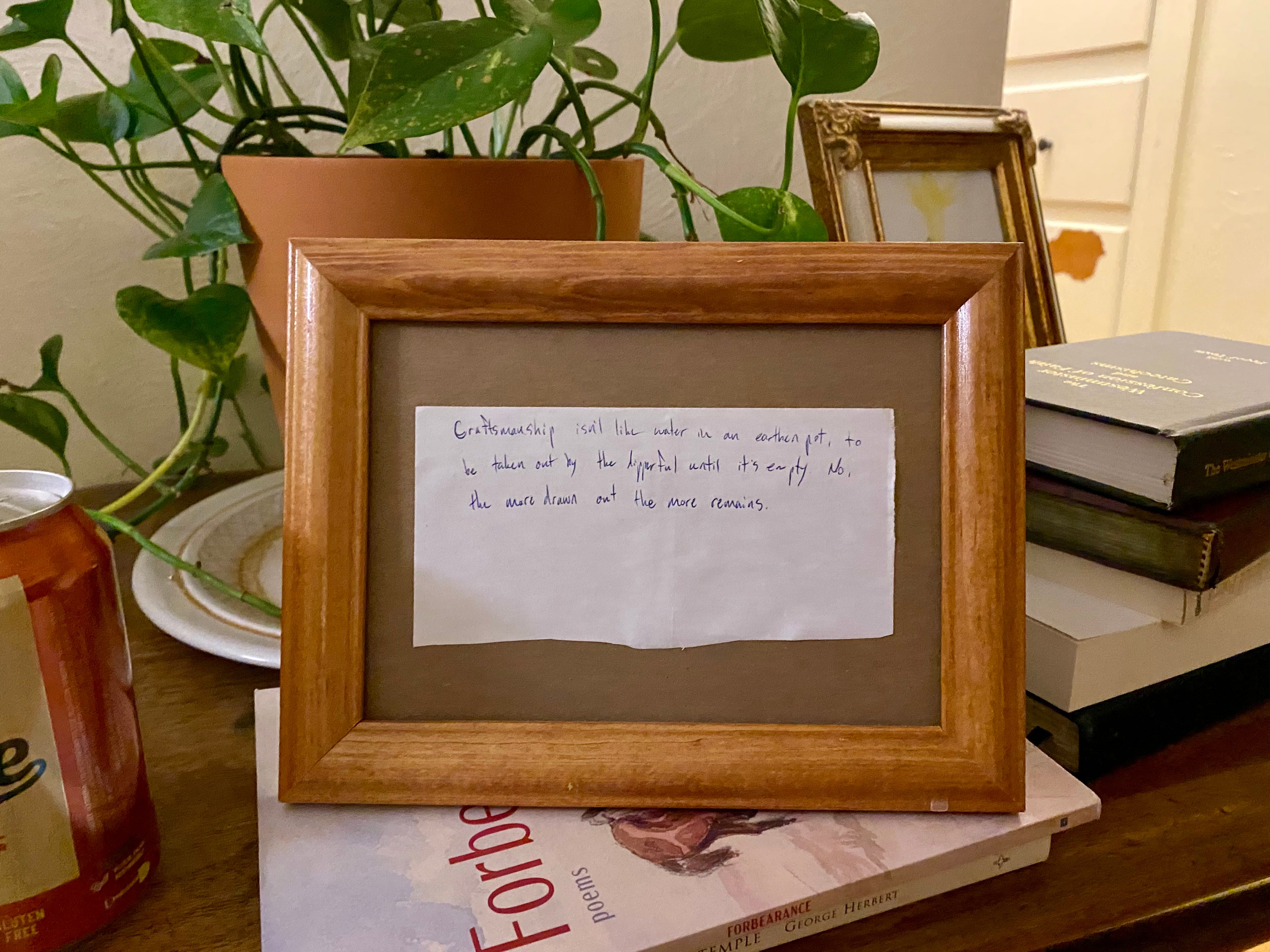
Craftsmanship isn't like water in an earthen pot, to be taken out by the dipperful until it's empty. No, the more drawn out the more remains.
If life is a loom, the pattern you weave is not so easily unraveled.
Annlaw was silent and intent; his lined face had brightened; the years had fallen away from it. Taran felt his heart fill with a joy that seemed to reach from the potter to himself, and in that moment understood that he was in the presence of a true master craftsman, greater than any he had ever known.
Count the deed, not the thought.
I have the sword I fashioned, Taran proudly cried, the cloak I wove, and the bowl I shaped. And the friendship of those in the fairest land of Prydain. No man can find greater treasure.


to read: essays and articles
on the body, sex, and procreation—in medicine, society, and our own lives:
The Labour of Presence — Rachel Roth Aldhizer, Comment — “Those two women are still working. Their work will not end. The work of touch, of care, of answering a call in the middle of the night and taking a child cannot be subsumed by our technicoloured dreams for a future where humans merely leisure. That’s a man’s world, a man’s dream. That world is no place for women and children… Those preoccupied with the ills of the rise of artificial intelligence—and there are ills—need to practice touching other bodies, that work women were made to do. The poor will always be with us. The elderly and the sick will remain. There will always be Davids enough to go around. The harvest is ripe, but the workers are few.”
Reminded me of this piece for which the one and only Kerri Christopher was interviewed.
On the heels of completing Carnes’ book on beauty, it’s also a good time to re-up Rachel’s lovely essay What Is Beauty For? which has been shared here previously.

Pearl — Kate Bluett, Turn Me Back Again —
"let go your own earth—dust to dust—forget
what you have known or been or done or wanted.
Lose everything and yet remain undaunted
in your belief the pearl will be your own,
once you yourself are but the pearl’s alone.
Let go the thoughts and passions that have stormed
within you, and let all things be transformed
beneath your shell, and find then that the world
has all been changed, and all things are empearled.”How Pornography Makes Us Less Human and Less Humane — Matthew Lee Anderson, The Gospel Coalition — “The path toward seeing how pornography dehumanizes begins here, in thinking about the death of wonder in our hearts and our lives. But I do not speak of wonder about sex—not yet, anyway. The death of mystery in that realm is only one manifestation of a more general disease, a pornification of our eyes and our minds that extends well beyond the realm of sexual stimulation.”
Was reminded I had had this one saved (for years actually), but since he’d been reflecting on similar themes recently, here and here I decided it was time to crack my knuckles and dive in. It is lengthy but it is excellent.
Perhaps one day I will more fully flesh out this idea: That, because fertility is just as much a part of sexuality as intimacy, bonding, and pleasure—its voluntary, medicalized disintegration from our person is violent in a way not unlike the digital degradation of pornography. This disintegration requires a lack of reverence for sexuality, as evidenced by modern medicine and the internet alike.
Added to this compilation
A Muted World Requires Fresh Approaches to Evangelism — Hayden Nesbit, The Gospel Coalition — “In an age of distorted relation to the world and others, how is the church supposed to bear witness to the Creator of a muted creation? Our evangelism must help people recover attentiveness to God’s world, where creation still witnesses to its Creator and exposes our alienation from him…
This atrophied ability to resonate with the world threatens to further cut us off from a transcendent story of salvation. Herman Bavinck argues that without general revelation (God speaking via his creation), special revelation (the transcendent story of salvation) loses its connectedness with the whole cosmic existence and life.”
This dovetails well with aspects of Anderson’s article above. We first have to grasp what Hayden is saying ourselves, as Christians, if we are to be any salt and light. And I fear a profound disconnect in the realm of body, sexuality, and procreation—though it is a broader issue as he lays out. Christianity has so much to offer a muted world.
Also loved his essays Resonance and the Pslams and Polishing Kernels: Bodily Control as New Gnosis, shared here previously.
Today’s Bioethics Isn’t Ready for Tomorrow’s Family Planning — Patrick T Brown, Family Matters — “America tends to be a deeply practical nation, not a philosophical one. But choosing not to ask these deeper questions is as much of a way of answering them as coming down with a carefully considered legal regime.”
This could be an evergreen statement about more than just our nation generally.
The Individual and Societal Cost of Gynecology’s Birth Control Fixation — Kristen Curran, Natural Womanhood — “Women may think, Am I the only person going through this? If millions of women had the same problem as me, surely there would be a better solution by now. Or maybe there’s just something wrong with me, and I can’t handle the same pain everyone else feels. Birth control as a catch-all solution erodes faith in medicine, silences suffering, and facilitates a societal pattern of not taking women seriously.”
It’s a societal pattern wrapped up in spiritual realities. Satan hates women in a particular way, so we shouldn’t be surprised when this shows up in entire ecosystems of healthcare.
Infertility and Faithfulness — Sharon Rhyne — “When you look at your barrenness, remember: It is in His nature to drench alters in water before consuming the place in flame. We aren’t going to be Elijah’s, but we do have the call on our lives to offer ourselves as living sacrifices. We aren’t Sarah, but we know that the same God who remembered her, will remember us.”
I’m grateful for the grounded, clear-eyed, yet surprisingly poetic ways Sharon writes about topics such as embryonic personhood and the body, among others, such as the wisdom of the garden.
Too Early to Count — Phylicia Masonheimer, Every Woman a Theologian —
“I think of how early the angel came
to Mary, how she heard those two lines:
“You who are highly favored,
the Lord is by your side.”
She could not pretend away the miracle
or hide the promise now in store;
no going back to how it was before.”
Each added to their respective sections in here.

Thanks to Fairer Disputations for sharing our recent interview in their weekly roundup.
Thanks to Emma Waters for including this compilation among other resources for pastors and churches.

more resources:

![the [female] body: a compilation](https://substackcdn.com/image/fetch/$s_!wWgM!,w_140,h_140,c_fill,f_webp,q_auto:good,fl_progressive:steep,g_auto/https%3A%2F%2Fsubstack-post-media.s3.amazonaws.com%2Fpublic%2Fimages%2F4915e0a2-6b60-42c4-93c8-748af2fa1f4c_480x360.jpeg)

![the [desecrated] body: a compilation](https://substackcdn.com/image/fetch/$s_!dRya!,w_140,h_140,c_fill,f_webp,q_auto:good,fl_progressive:steep,g_auto/https%3A%2F%2Fsubstack-post-media.s3.amazonaws.com%2Fpublic%2Fimages%2F5c9d3ae9-c6b3-42ba-a5db-f5b7f91da982_555x600.jpeg)
to watch, listen to
Continuing On:
Mere Fidelity — Mere Orthodoxy — Protestants and History / How to Approach God — “How do you differentiate or distinguish between tradition and history?” // “Anything you don’t like in the past, you can say well that’s the Catholic bits so of course that’s wrong… so it gives you this out where anytime you don’t like what was said, you can blame that on the corruption of Christianity after Constantine… that’s just assumed, so when that’s assumed and then you bring in tradition and history selectively, you’re gonna get nowhere because you always have that out.”
Woven Well — with Caitlin Estes — Episodes 151-154 — Naturally Increasing Progesterone / Do PCOS Cycles Work with Fertility Awareness Methods? / Were Christians against Birth Control for Centuries? — “What a great call to examine our hearts and motivations… we must ask ourselves, and on a continual basis: Why are we avoiding pregnancy?”



Rachel Roth Aldhizer’s pieces were exactly what I needed today. Thank you for sharing them.
“My mom friends joke that in caring for our children we have become dumber versions of ourselves…although I prefer to imagine ourselves not as dumbing down but as growing focused, streamlined, and rigorous in the biological pursuit of love unfolding before our eyes. A single-mindedness oriented toward the care of the other is all-consuming.”
Anyway, this paired with her essay What is Beauty For? is such a balm. Truly lovely thoughts and beautiful writing.
Your note on Sharon Rhyne’s writing was perfect, too. I agree.
Always appreciate your compilations.
I'm thrilled that you enjoyed my book, Haley! Thanks so much for the review -- those really make a difference.